
In development · Patent pending
A voice companion for
home physical therapy.
Milo sits on the nightstand and talks your patient through the protocol you prescribed. It times the holds, counts the reps, and tells you who actually did the work.
The problem
Most people stop.
- 35%
- fully adhere to their home exercise program
- 65%
- abandon it within the first month
The number has barely moved in thirty years — 19% in 1993, 35% in 2005. Every tool in the chain asks the patient to do something at the exact moment they are least able to. A handout goes in a drawer. An app needs a free hand. By week two the protocol has drifted.
How it works
No app. No login.
Nothing to hold.
- 01
It speaks
Your protocol, out loud, in order. Holds timed, rests kept, in a voice that waits for them.
- 02
It counts
A small sensor worn on the ankle or wrist counts the reps and measures the holds. Measured, not self-reported.
- 03
It reports
Completion, streaks and days missed come back to the clinic before the next visit.
Milo does not diagnose, does not change the plan you set, and does not replace a visit. The clinician stays the clinician.
The device
This is Milo.
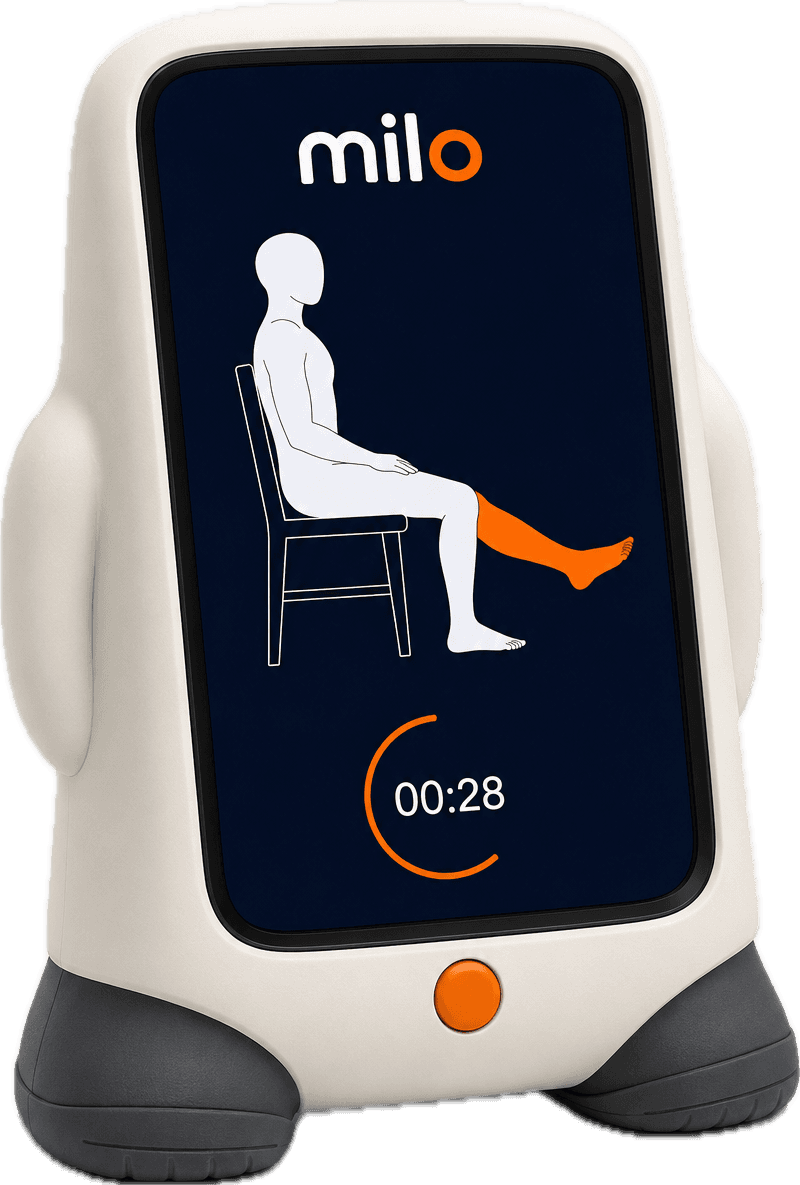
It stands on its own feet, talks your patient through the work, and shows the movement it is asking for. Made to sit out on the nightstand, not live in a drawer.
- It shows the exercise
- The screen draws the movement it is asking for, with the working limb picked out. A patient checks the picture once, gets into position, and listens from there.
- One button
- A ring for the hold, a button for everything else. Nothing to read up close, nothing to log into.
- No setup
- Stands on its own feet to face you. No stand, no mounting, nothing to assemble. One port in the back — joins your home Wi-Fi once and never asks again.
What you get
A companion, a sensor,
and a clinic portal.
The companion
Sits on the nightstand and plugs into the wall. One button. Speaks the programme your clinician set, exercise by exercise — times every hold, paces every rep, rests you between sets. Joins your home Wi-Fi once and never asks again.
The sensor
A small clip worn on the ankle or wrist for the session. Counts the reps you actually do and how long you actually hold. Charges over USB-C. Without it, Milo still paces and times you — it just says so in the record.
The portal
Where your clinician builds the programme from a library of standard exercises, in about two minutes, and sees what happened: sessions done, reps completed, holds held. Counts, not judgement.
- Private by designSpeech is recognised on the device itself and discarded. No audio is recorded or sent anywhere — not to us, not to anyone.
- No namesYour clinic assigns a code. Milo never stores who you are.
- Works when the Wi-Fi does notSessions are saved on the device and sent when the connection comes back.
- What it will not doDiagnose, change your exercises, or judge your form. The clinician stays the clinician.
Not shipping yet
Want to know when it is real?
The clinic portal is live. The device is being built on off-the-shelf hardware, and the enclosure is still a render. If you run a clinic and want to be in the first pilot, or you just want to hear when it ships, leave an address.